Using AI to Improve Hreflang at Scale:
How We Planned Our Proof of Concept (Part 1)
By Precision Plugins – Practical tools for ambitious websites.
Hreflang can still be hard, can AI hreflang help?
For all the complexity in modern SEO, few things cause more quiet frustration than hreflang.
It’s essential for international visibility, yet brittle in practice. One missing URL or one misaligned country code and suddenly you get a forest of errors in your validation tool, leading to the wrong pagebeing served to the wrong market.
At Precision Plugins we’ve built a modern, easy–to–use hreflang manager. Over the past few months we’ve been exploring whether AI can help identify better hreflang candidates across large, multi–market websites. Not to replace SEO professionals, but to give them a faster, more reliable starting point.This two–part series shares how we approached the challenge, what we learned, and where AI fits (and doesn’t fit) in the workflow.
Part 1 focuses on planning the Proof of Concept. Part 2 will cover our findings.
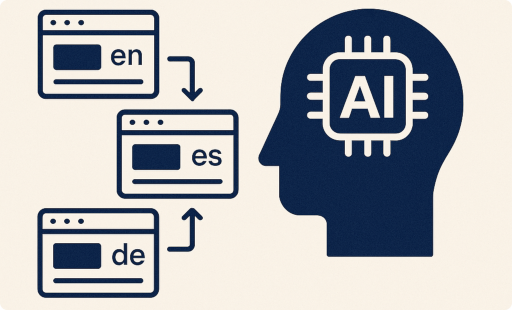
On paper, hreflang is simple. In reality, it breaks for reasons that have nothing to do with SEO skill:
- Getting started from zero hreflang tags is a mountain to climb.
- Different markets use different URLs, structures, or product names.
- Some country sites are “poor cousins” to the original or what is perceived as the “main” site.
- CMS translations aren’t 1:1.
- Editors change slugs without updating references.
- Country variants expand over time.
- Large enterprise sites decentralise content ownership.
Most issues are operational, not conceptual. And while existing tools validate tags or highlight mapping
gaps, they rarely answer the harder question:
“What should the correct alternative URL be?”
This is where AI seemed worth exploring – not as a magic wand, but as a way to identify smart
suggestions that humans can verify.
We weren’t looking to build an “auto–hreflang” engine. That feels premature and risky.
Instead, we asked a simpler and more valuable question:
“Can AI help identify the most likely equivalent page in another language or region?”
If the answer is yes, SEO professionals or site editors could:
- Generate a reasonable starting list of hreflang candidates from nothing.
- Catch missing relationships early.
- Understand structural inconsistencies across markets.
- Identify the “poor cousin” sites with asymmetric mappings.
It’s a practical layer of intelligence – not a replacement for expertise.
Before writing a line of code, we defined what success would look like. This step was crucial to avoid
drifting into a general AI experiment.
Our Proof of Concept needed to:
- Test feasibility
Could an LLM reliably interpret page context and propose the right URL? - Identify failure modes early
Where does it hallucinate? Where does it struggle? Where is it confidently wrong? - Evaluate accuracy at scale
It’s one thing to succeed on five examples, another on five hundred. - Establish boundaries
We need consistency, reproducibility, and ways to stop AI from overfitting the test data. - Understand the costs
Latency, tokens, and feasibility inside a plugin environment. - Produce a practical output
We wanted structured suggestions that a human could quickly accept or reject.
Having this framework kept us focused and ensured the project aligned with real SEO workflows.
AI research can easily spiral into heavy architecture. We intentionally avoided that.
Instead, we looked for suppliers and tools based on four principles:
- Reliability of the model
We needed consistent behaviour and strong multilingual understanding. - Clear token pricing & predictable costs
A PoC needs to show whether this is economically viable, especially at future scale. - Strong embeddings support from a stable API
Not for full RAG yet – but for clustering pages and measuring similarity.
The client APIs are a fast–moving target, so we looked for maturity, speed, and reliability. - Ease of evaluation
We wanted to run repeated prompts, score output, and compare iterations quickly.
No user is going to sit there watching a spinner for 60 seconds whilst the AI does its thing.
We won’t list every tool here – partly because stacks evolve quickly, but also because the thinking
matters more than the catalogue.
Before testing, we created a controlled environment to avoid common pitfalls.
- Synthetic or publicly accessible URLs
No client data. No risks.
We built test sets representing typical multilingual structures. The test data
deliberately included tricky translations and a “poor cousin” site with far fewer URLs. - Page context extraction
We looked at:- titles
- headings
- meta descriptions
- URL patterns
- light page summaries
All lightweight enough for a prototype.
- Evaluation
We used what was known as “IEB Eyeball” in my IBM days – studying the output carefully, drawing
conclusions from the results, and testing those conclusions in further runs. - Boundaries
Clear rules:- Don’t fabricate non–existent URLs.
- Only choose from allowed candidate languages, if provided.
- Return structured JSON.
- Include a confidence score.
This prevented a lot of chaos.
- Documentation from day one
A PoC without notes becomes a dead project in a month.
We documented reasoning, prompts, surprises, and edge cases as we went.
We set realistic expectations. AI is powerful, but it’s not a magic matchmaker.
We predicted:
- AI would understand clear equivalents
(e.g.,/en/product/red-shoes↔/de/produkt/rote-schuhe) - It would struggle with ambiguous content
(e.g., about–us type pages that could match to almost anything semantically) - It might invent URLs
A known risk – hence the boundaries. - It would help expose structural inconsistencies
Which is often more useful than the match itself. - It wouldn’t replace human oversight
Nor should it.
SEO teams don’t need “AI magic.” They need reliable shortcuts that reduce manual labour without
compromising accuracy.
If AI can provide strong candidates, even at 70–80% precision, it becomes a valuable assistant:
- Rapid start–up from no or very few hreflang tags.
- Accelerating audits.
- Catching mismatches.
- Standardising patterns.
- Supporting large–scale migrations.
- Improving international expansions.
Our PoC was designed to test whether this is realistic – and if so, where it fits into a professional
workflow.
In the next post, we’ll share:
- What worked surprisingly well.
- What didn’t work at all.
- Real examples of AI successes and failures.
- The conditions where AI excels.
- The conditions where humans remain essential.
- How this will influence the future of Precision Plugins’ tooling.
Not every step of the PoC was smooth – and that’s exactly why it’s worth sharing.